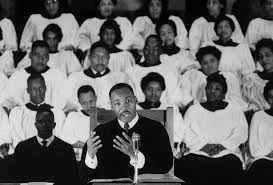
Hi and welcome back to week 6 of my blog! This past week we learned about how the black church provided crucial support to the emerging civil rights movement. The black church provided critical support to the emerging civil rights movement in that they were able to support their own ministers. Although not all black ministers committed their churches to the movement, a sizable number of the new urban ministers were educated middle-class devotees to a radical theology stressing social activism, and these ministers became key leaders of the civil rights movement. The black church also provided leadership, meeting places, and numerous cultural resources which were all very important during the civil rights movement. Many young people provided key roles in the civil rights movement. For example, in 1960, large number of black students participated in waves of sit-ins that galvanized the civil rights movement and stimulated increased participation by white and black students in the northern United States. Black students founded the student nonviolent coordinating committee (SNCC) and organized numerous campaigns, including freedom summer, which brought hundreds of northern white students to Mississippi in 1964 to register black voters and fight for civil rights in the state. Various tactics were used by the youth participating in various social movements in Canada, France, the United States, Britain and Germany. In Canada, students first mobilized around the anti-nuclear issue in 1959, developing a view of “the common welfare over partial interests, of humanity over politics” that would become central to the larger university movement of the 1960s. In France, massive mobilizations of students began during the Algerian War, which lasted from 1954 to 1962, to support the Algerian National Liberation Front. Students in the United States began organizing on campuses in the late 1950s to support civil rights movement and to protest U.S. Cold War policies. In Britain, teach-ins about the war were held at the London School of Economics and at Oxford in the summer of 1965 in support of the American anti-war movement. Finally, in Germany, they adopted tactics such as sit-ins and teach-ins, styles of dress, and their own versions of slogans from the American New Left and black power movements. In all, many groups of people provided the civil rights movement with much support and guidance. Thank you for tuning in and I will be back shortly.
 Civic Media Blog